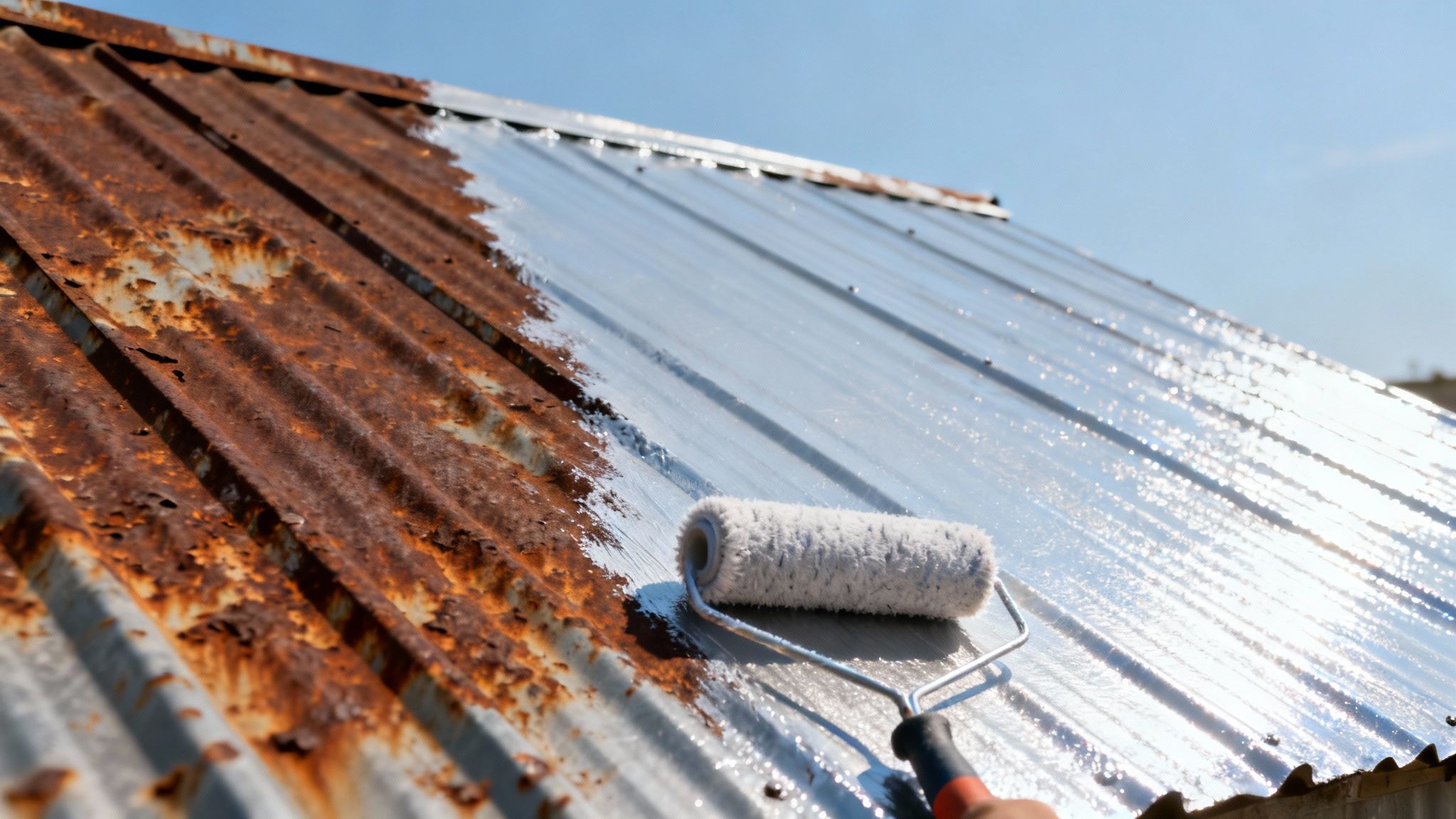
Salt-Air Roof Corrosion
Salt-Air Roof Corrosion on a Newark-area commercial building usually shows up as a ceiling stain, a tripped alarm, or a tenant call long after the roof detail first failed. Commercial Roofers of New Jersey traces the problem back to the source before closing it out. What follows is a straight read on the work and the calls that go into it.
The stain almost never marks the entry point. Salt-Air Roof Corrosion on a Newark-area roof is detective work — following the water back through seams, penetrations, curbs, drains, and what the interior shows us until the real source turns up. Patch the symptom and the cause just keeps going.
As we go we document the failed detail, the surrounding condition, and the extent of water travel inside the roof. Those findings decide the call: a targeted repair if the assembly supports it, or recover and replacement when the damage has gone too far for a patch.
For an occupied property in Newark, we often get a watertight temporary measure in place first so operations continue while the lasting repair gets planned properly. On a tight urban lot, where the dumpster, the material hoist, and the crew’s path to the roof go is half the planning. We sort out staging, deliveries, and protection of the sidewalk and entrances up front so the work does not collide with how the building is used.
After the interior is safe, we fix the source with materials compatible with what is already on the roof — a mismatched patch is just the next failure — and we note any effect on the warranty and on how the roof should be maintained going forward.
Ponding is a quiet killer on flat North Jersey roofs. Standing water after a storm points to drains that have lost pitch, sagging insulation, or a deck that has moved, and left alone it degrades the membrane and adds weight the structure was never meant to carry. We map where water sits before it becomes a leak.
Wind off the Newark Bay flats finds the perimeter first. Edge metal, coping, and the membrane attachment at the corners and eaves take the brunt of uplift, and once an edge lifts, a gust can peel a field that was otherwise sound. We treat the perimeter and corners as the make-or-break zones they are.
We factor all of it into the recommendation, because a North Jersey roof that is only planned for fair weather is a roof that gets re-planned the hard way after the next freeze, storm, or ponding season.
There is no pitch up front — there is a roof walk. We look at the actual assembly and talk through the decision you are facing, whether that ends up being salt-air roof corrosion or something else the roof needs, and you leave with a documented recommendation rather than a sales call.
Because most Newark and North Jersey buildings we work on stay open during the job, we schedule and stage around how the property actually operates and keep you informed at each step. What you are left with is a roof decision that lasts and an operation that kept moving the whole time.
Nothing gets priced until the roof condition and the recommendation are on paper. Everything gets written down: the assembly we found, the conditions we photographed, the areas we protected, and the decision we are recommending. That record is what lets an owner approve work with confidence instead of guessing.
Written findings are what let an owner approve work with confidence. For salt-air roof corrosion we document the assembly, the conditions, the access constraints, and the recommended option with photographs, so the decision can be defended to ownership, a lender, or an insurer without relying on anyone’s memory of a site visit.